Introduction
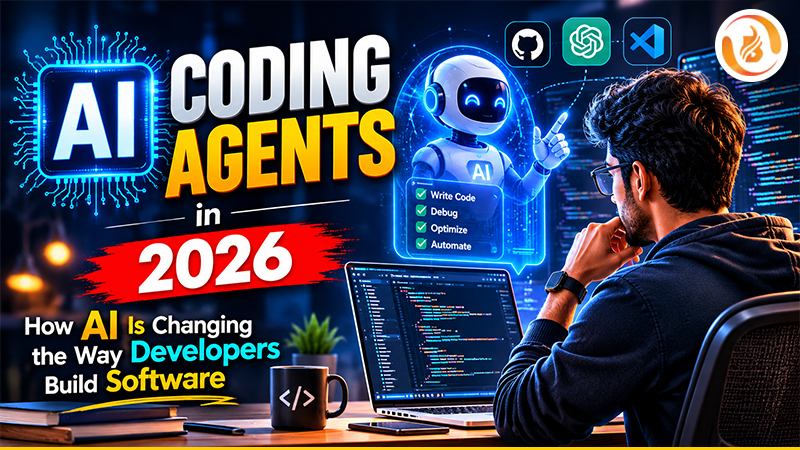
Artificial intelligence is changing the way software is designed, developed, tested, and maintained. In 2026, AI has moved beyond basic code autocomplete and simple programming assistance. AI coding agents are becoming more capable of understanding development tasks, analyzing codebases, generating code, running tests, identifying errors, and assisting developers throughout the software development lifecycle.
This evolution is creating new opportunities for businesses and IT service providers. Instead of viewing AI as a replacement for software developers, organizations can use it to enhance developer productivity, accelerate project delivery, and improve software development workflows.
So, what are AI coding agents, how do they work, and how can businesses benefit from combining AI technology with experienced software development teams?
What Are AI Coding Agents?
AI coding agents are AI-powered software development tools that can perform multiple steps of a programming task with limited human intervention.
Traditional AI coding assistants generally help developers generate code, explain programming concepts, or suggest improvements. AI coding agents can work on broader development objectives by interacting with project files, development tools, testing environments, and code repositories.
Depending on their capabilities and permissions, an AI coding agent can help with:
- Writing and modifying source code
- Finding and fixing software bugs
- Generating automated tests
- Reviewing existing code
- Refactoring applications
- Analyzing codebases
- Investigating technical errors
- Creating documentation
- Supporting repetitive development tasks
The important difference is that AI coding agents are designed to work toward a development objective, rather than simply respond to individual coding questions.
How AI Coding Agents Are Changing Software Development
The biggest change is the transition from manual implementation toward AI-assisted software engineering.
For example, a developer may provide a requirement for a new application feature. An AI coding agent can help identify relevant files, suggest an implementation approach, generate code, create tests, and identify potential problems.
The developer remains responsible for reviewing the implementation and deciding whether the solution meets the project’s technical and business requirements.
This creates a more collaborative workflow where developers direct and validate AI-generated work instead of relying on AI to make every technical decision.
For IT service providers, this can create opportunities to deliver projects more efficiently while maintaining professional engineering standards.
AI Coding Agents vs AI Coding Assistants
AI coding assistants and AI coding agents are related but not identical.
An AI coding assistant typically responds to a specific developer request. For example, a developer might ask an assistant to generate a function, explain an error, or suggest a programming solution.
An AI coding agent can work across a larger task. It may analyze project context, modify multiple files, execute tests, review results, and suggest additional changes.
However, greater automation does not remove the need for experienced developers.
A professional development team still needs to determine whether the generated solution is secure, scalable, maintainable, cost-effective, and aligned with the customer’s requirements.
Benefits of AI Coding Agents for IT Service Providers
AI coding agents can provide several practical advantages for software development companies.
1. Faster Development Workflows
AI can assist with repetitive implementation tasks, allowing developers to spend less time on routine coding and more time on complex engineering decisions.
This can help IT companies shorten development cycles without compromising their development processes.
2. Improved Developer Productivity
Developers can use AI to quickly explore unfamiliar code, generate initial implementations, create tests, and investigate technical problems.
The result is not simply faster coding. It can give developers more time to focus on architecture, performance, security, and user requirements.
3. Faster Prototyping
Businesses often need prototypes to evaluate an idea before investing heavily in development.
AI-assisted development can help teams create early versions of applications more efficiently, allowing businesses to test concepts and gather feedback sooner.
4. Support for Software Maintenance
Maintaining an existing application can require significant developer time.
AI coding agents can assist teams in understanding legacy code, identifying repetitive tasks, preparing documentation, and suggesting potential improvements.
Human developers can then review and implement the appropriate changes.
Why Human Software Developers Still Matter
One of the biggest misconceptions surrounding AI coding agents is that they will completely replace software developers.
In reality, professional software development involves much more than writing code.
Developers need to understand business objectives, user requirements, system architecture, security considerations, integration requirements, infrastructure, performance, and long-term maintenance.
AI can generate a technical solution, but an experienced developer must determine whether that solution is actually appropriate for the business.
Human expertise is especially important for complex projects where a small technical decision can affect scalability, security, reliability, or future development costs.
Therefore, the future is not necessarily AI versus developers.
It is AI working alongside developers.
AI Coding Agents and Software Quality
Speed is valuable, but software quality remains critical.
AI-generated code should be reviewed and tested before it becomes part of a production system. Developers should verify functionality, security, performance, maintainability, and compatibility with the existing application.
IT companies can establish structured AI-assisted development processes that include:
- Human code review
- Automated testing
- Version control
- Security scanning
- Access management
- Development environments
- Code quality checks
- Performance testing
- Deployment controls
This approach allows organizations to benefit from AI automation while maintaining professional software engineering standards.
What Does This Mean for Businesses?
For businesses planning a new software project, AI coding agents can become part of a modern development strategy.
Companies can potentially use AI-assisted development to accelerate prototypes, improve development productivity, automate repetitive engineering activities, and support application maintenance.
However, businesses should not choose a software development partner based only on whether it uses AI tools.
The more important questions are whether the development team understands the business problem, technology requirements, security expectations, scalability needs, and long-term objectives.
AI is a development accelerator. Experienced software engineers provide the expertise required to use that accelerator effectively.
The Future of AI-Assisted Software Development
The future of software development will likely involve deeper collaboration between developers and AI systems.
AI coding agents may increasingly assist with requirements analysis, coding, testing, debugging, documentation, security checks, and application maintenance.
Multiple specialized AI agents could also work together, with different agents handling different stages of a software engineering workflow.
However, human developers will continue to play an important role in architecture, technical strategy, quality assurance, security, client requirements, and final decision-making.
For IT service providers, this represents an opportunity to combine AI-powered productivity with experienced software development expertise.
Conclusion
AI coding agents are changing software development in 2026 by helping developers automate repetitive tasks, accelerate coding workflows, improve testing, and work more efficiently with complex codebases.
But AI coding agents should not be viewed as replacements for professional software development teams. Their real value comes from augmenting skilled developers and helping them deliver better software more efficiently.
For businesses, the strongest approach is to combine modern AI development tools with experienced engineers, strong security practices, structured testing, and a clear understanding of business requirements.
The future of software development is not about choosing between AI and developers. It is about giving developers better AI-powered tools so they can build smarter, faster, and more reliable software for businesses.
Visit: www.biovustechnologies.com
Frequently Asked Questions
What are AI coding agents?
AI coding agents are AI-powered software development tools that can assist with multi-step programming tasks such as writing code, modifying files, generating tests, debugging, and analyzing software projects.
Are AI coding agents replacing software developers?
No. AI coding agents are primarily productivity tools. Experienced developers are still required for architecture, business requirements, security, testing, technical decisions, and final software validation.
How can AI coding agents help software development companies?
They can help development teams automate repetitive tasks, accelerate coding, support debugging, generate tests, assist with code maintenance, and improve overall development productivity.
Are AI coding agents useful for custom software development?
Yes. AI coding agents can assist custom software development teams with implementation, testing, documentation, debugging, and code analysis. Human developers remain responsible for ensuring that the final solution meets the customer’s requirements.
Is AI-generated code reliable?
AI-generated code can be useful, but it should always be reviewed and tested. Developers should validate functionality, security, performance, maintainability, and compatibility before using AI-generated code in production.
What skills will software developers need in 2026?
Developers will continue to need strong programming and software engineering fundamentals. In addition, knowledge of AI-assisted development, system architecture, cybersecurity, cloud technologies, testing, and AI agent workflows can become increasingly valuable.
Should businesses use AI coding agents for software projects?
Businesses can benefit from AI-assisted development when it is implemented responsibly. The best results come from combining AI tools with experienced software developers, proper testing, security controls, and clear business requirements.
What is the future of AI coding?
The future is likely to involve closer collaboration between AI coding agents and human developers. AI can handle more repetitive and multi-step development tasks, while developers focus on architecture, strategy, quality, security, and business-focused software decisions.