
In recent months, global media have reported a provocative claim: Chinese scientists are working on what some outlets describe as the world’s first “pregnancy robot”, a humanoid machine capable of carrying a human fetus from conception to birth. With a potential prototype projected as early as 2026, this news has captured public imagination, raising excitement, curiosity, and skepticism.
But what does this technology actually involve, and how close is it to reality? Let’s break it down.
The Concept of a Pregnancy Robot
The idea is that a humanoid robot could house an artificial womb system, where a fertilized embryo would grow under controlled conditions. Key claims about such a robot include:
- Providing a gestational environment similar to a human womb.
- Supplying nutrients, oxygen, and fluid through an automated system.
- Carrying a fetus to full term and “delivering” a baby.
Media reports suggest that this technology could serve as an alternative to traditional surrogacy, especially for couples facing fertility challenges or health risks associated with pregnancy. However, it is important to note that no verified scientific institution has demonstrated a fully functional pregnancy robot, and these claims remain speculative.
Technologies Behind the Pregnancy Robot
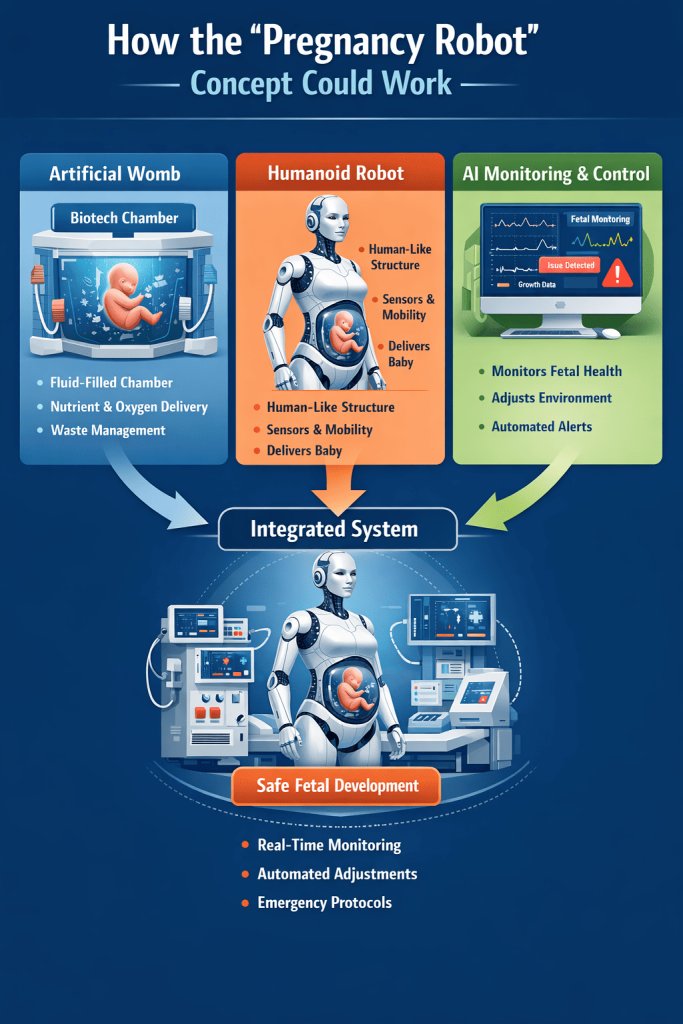
The concept relies on the convergence of three main technological areas: artificial womb systems, humanoid robotics, and artificial intelligence (AI).
1. Artificial Womb Technology (Ectogenesis)
Artificial wombs aim to support fetal development outside a human body. Their key components include:
- Fluid-filled gestational chamber that mimics the amniotic sac.
- Nutrient and oxygen delivery system simulating placental function.
- Waste removal system to maintain a safe environment.
- Temperature and pressure regulation for optimal growth conditions.
Current Status:
- Successful trials have been conducted in animals, including premature lambs.
- Human application is still limited to neonatal care for premature babies.
- Replicating a full-term human pregnancy in a machine remains extremely challenging due to the complexity of hormonal, immune, and physiological interactions.
2. Humanoid Robotics
Humanoid robots provide the structure and mobility for integrating artificial womb technology:
- Human-like body frame to house the gestational system.
- Sensors to monitor fetal development and environmental conditions.
- AI-assisted movement and interaction to simulate aspects of human physiology.
While China has advanced significantly in humanoid robotics, embedding delicate biological systems such as artificial wombs into a robot has not yet been achieved in practice.
3. Artificial Intelligence (AI)
AI could manage the pregnancy process by:
- Monitoring fetal growth, heart rate, and other vital signs in real-time.
- Adjusting oxygen, nutrients, temperature, and fluid levels automatically.
- Detecting potential complications early for immediate corrective action.
However, AI cannot fully replicate the complex feedback systems of a human body, and ethical and legal decisions cannot be automated.
Challenges and Limitations
Even if each technology is advanced individually, integrating them presents massive challenges:
- Safety and reliability: Maintaining stable conditions for a developing human fetus inside a moving machine.
- Ethical considerations: Determining the rights and welfare of a baby born via a robot.
- Legal and regulatory hurdles: Current laws do not cover machine-assisted human gestation.
- Biological complexity: Mimicking the natural maternal environment is far beyond current capabilities.
Ethical, Social, and Legal Implications
The concept of a pregnancy robot raises profound questions:
- Parenthood and identity: How would society view a child born via a machine rather than a human womb?
- Consent and rights: How would parental and medical responsibilities be managed?
- Access and inequality: Could this technology widen social and economic disparities?
Scholars, ethicists, and policymakers are already debating these questions, even though a working robot has not yet been developed.
Media Hype vs Reality
Many news outlets have sensationalized the idea, suggesting a working prototype could exist by 2026. Fact-checkers caution that:
- No scientific paper or peer-reviewed study confirms a functional humanoid gestation robot.
- Details of clinical testing, safety measures, or regulatory approvals have not been verified.
- Some reports may originate from early concept statements rather than confirmed engineering milestones.
In other words, while artificial womb research and humanoid robotics are real, the integration into a machine that can gestate a human baby remains speculative.
Conclusion
The “pregnancy robot” represents a fascinating intersection of biotechnology, robotics, and AI, but it is more a visionary concept than an imminent reality. Artificial womb research and humanoid robotics are advancing rapidly, yet significant scientific, ethical, and legal challenges remain.
As the world watches technological innovation unfold, the pregnancy robot serves as a lens to examine the possibilities, and limitations, of human ingenuity.
While it sparks debate about the future of reproduction, the practical realization of a robot that can safely carry and deliver a human baby is likely decades away.
Visit us at: www.biovustechnologies.com