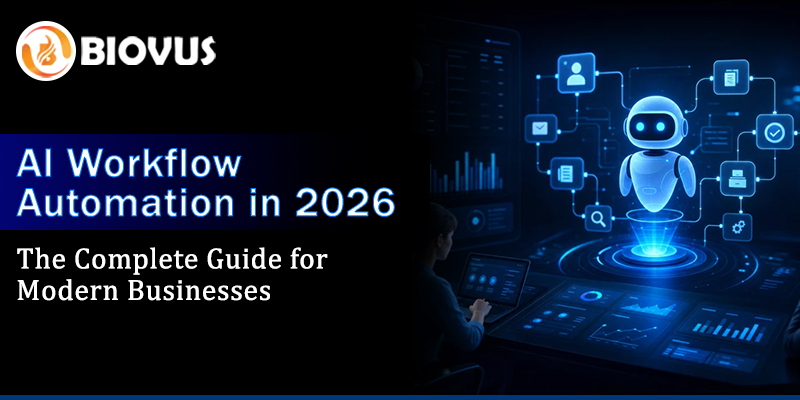
In 2026, businesses are no longer asking whether AI can improve operations. The real question is how fast companies can implement AI workflow automation before competitors move ahead.
From startups and eCommerce brands to healthcare providers and financial institutions, organizations across every industry are using AI-powered workflows to automate repetitive tasks, improve productivity, reduce operational costs, and scale faster than ever before.
AI workflow automation is no longer a future concept. It has become a business necessity.
What Is AI Workflow Automation?
AI workflow automation is the process of using artificial intelligence technologies to automate business operations, decision-making processes, and repetitive tasks.
Unlike traditional automation systems that rely only on predefined rules, AI-powered workflows can learn from data, analyze outcomes, adapt to changing conditions, and make intelligent real-time decisions with minimal human intervention.
This allows businesses to create smarter, faster, and more efficient operational systems.
Why AI Workflow Automation Matters in 2026
Businesses today operate in a highly competitive and fast-moving environment. AI workflow automation helps organizations stay agile, scalable, and efficient.
1. Reduced Operational Costs
AI automation reduces manual work, minimizes human errors, and optimizes internal workflows. This helps businesses significantly lower operational expenses.
2. Faster Customer Support
AI chatbots, virtual assistants, and automated support systems provide instant responses and improve customer satisfaction.
3. Managing Large Volumes of Data
Modern businesses generate enormous amounts of data daily. AI workflows can process, analyze, and organize this data efficiently.
4. Flexible Work Environments
As remote and hybrid work models continue to grow, AI-powered systems help teams collaborate efficiently from anywhere.
5. Competitive Business Growth
Companies using AI automation can scale operations faster, improve productivity, and respond to market demands more effectively.
Top AI Workflow Automation Applications Across Industries
1. Customer Service Automation
AI-powered customer service systems improve response times and reduce support workload.
Key Applications:
- AI chatbots for customer support
- Voice bots for calls and appointment scheduling
- Automated ticket routing systems
- Personalized customer interactions
Benefits:
- Faster support responses
- 24/7 customer assistance
- Reduced operational costs
- Improved customer satisfaction
2. Healthcare Process Automation
Healthcare organizations use AI workflow automation to improve patient care and administrative efficiency.
Key Applications:
- Appointment scheduling automation
- Medical data processing
- AI-assisted diagnostics
- Patient communication systems
Benefits:
- Reduced administrative workload
- Faster patient service
- Improved diagnosis accuracy
- Better healthcare management
3. Financial Services Automation
Financial institutions use AI automation to improve security, compliance, and customer service.
Key Applications:
- Fraud detection systems
- Automated loan processing
- AI-powered customer support
- Financial risk analysis
Benefits:
- Faster transaction processing
- Improved fraud prevention
- Better financial insights
- Enhanced customer experience
4. eCommerce Process Automation
AI workflow automation helps eCommerce businesses improve sales, inventory management, and customer engagement.
Key Applications:
- Product recommendation engines
- Automated inventory management
- AI-driven marketing campaigns
- Smart customer targeting
Benefits:
- Increased sales conversions
- Improved inventory accuracy
- Personalized shopping experiences
- Better marketing performance
AI Workflow Automation vs Traditional Automation
| Feature | Traditional Automation | AI Workflow Automation |
|---|---|---|
| Decision Making | Rule-based | Intelligent and adaptive |
| Learning Ability | No | Yes |
| Data Handling | Structured data only | Structured and unstructured data |
| Flexibility | Limited | Highly flexible |
| Human Interaction | Minimal understanding | Context-aware communication |
| Optimization | Requires manual updates | Continuous self-improvement |
Key Benefits of AI Workflow Automation
Improved Productivity
AI automation handles repetitive and time-consuming tasks, allowing employees to focus on strategic thinking, creativity, and business growth.
Cost Savings
Businesses can reduce operational expenses by minimizing manual processes and eliminating repetitive work.
Scalability
Organizations can scale operations quickly without significantly increasing workforce requirements.
Better Decision-Making
AI systems analyze large amounts of data in real time to identify trends, opportunities, and workflow bottlenecks.
Enhanced Customer Experience
AI enables personalized customer interactions, faster responses, and round-the-clock support.
How to Successfully Implement AI Workflow Automation
Step 1: Identify Repetitive Tasks
Start by identifying tasks that consume time and require manual effort.
Common Automation Areas:
- Data entry
- Customer support responses
- Invoice processing
- Email follow-ups
- Reporting tasks
Step 2: Define Automation Goals
Set clear objectives before implementing AI automation.
Examples:
- Increase productivity
- Reduce operational costs
- Improve customer experience
- Optimize workflows
- Increase business efficiency
Step 3: Choose the Right AI Automation Tools
Select tools that align with your business goals and operational requirements.
Important Considerations:
- Workflow automation platforms
- AI analytics tools
- CRM and ERP integrations
- Cloud-based automation systems
- Scalability and security
Step 4: Ensure Secure Integration
Data security and seamless integration are essential for successful AI workflow implementation.
Businesses should use secure systems that protect sensitive information while maintaining operational efficiency.
Step 5: Test and Optimize
Before launching automation workflows, businesses should perform testing, validation, bug fixing, and optimization.
Continuous monitoring helps improve workflow performance and scalability over time.
Future Trends in AI Workflow Automation
The future of AI automation is evolving rapidly.
Key Trends in 2026:
- Autonomous AI agents
- Intelligent business process automation
- AI-powered decision systems
- Enterprise-wide workflow integration
- Human and AI collaboration
- Predictive automation systems
Businesses adopting these technologies early will gain a major competitive advantage.
Why Choose Biovus for AI Workflow Automation Solutions?
Biovus provides advanced AI workflow automation solutions designed to help businesses improve productivity, automate repetitive operations, and accelerate growth.
Our AI-powered solutions are scalable, intelligent, and customized to meet modern business requirements across industries.
We help businesses:
- Reduce operational costs
- Improve workflow efficiency
- Automate repetitive processes
- Increase scalability
- Enhance customer experience
- Accelerate digital transformation
With innovative AI strategies and professional implementation services, Biovus enables organizations to achieve long-term business growth through smart automation.
Visit: www.biovustechnologies.com
Frequently Asked Questions (FAQ)
What are the benefits of AI workflow automation?
AI workflow automation improves productivity, reduces manual errors, enhances customer support, lowers operational costs, and increases scalability.
Which industries use AI workflow automation?
Industries such as healthcare, finance, retail, logistics, education, manufacturing, and eCommerce actively use AI workflow automation.
Why is AI workflow automation important in 2026?
AI workflow automation helps businesses improve efficiency, make faster decisions, reduce costs, and remain competitive in a rapidly evolving digital market.
Can small businesses use AI workflow automation?
Yes. Small businesses can use AI automation tools to streamline operations, improve customer service, and scale efficiently without large operational costs.
Is AI workflow automation secure?
Yes. Modern AI workflow systems include advanced security features, encrypted data handling, and secure integrations to protect business information.