Artificial Intelligence is rapidly transforming how businesses operate, automate processes, and interact with customers. While traditional software has powered businesses for decades, a new generation of intelligent systems known as AI Agents is changing the way organizations approach productivity, decision-making, and automation.
In 2026, businesses across industries are increasingly adopting Agentic AI solutions to streamline workflows, reduce manual effort, and create more adaptive digital experiences. But what makes AI agents different from traditional software, and why are organizations making the shift?
What Is Traditional Software?
Traditional software is designed to perform specific tasks based on predefined rules and programmed instructions. It follows a structured workflow where every action is determined by the logic created by developers.
Examples include:
- CRM software
- Accounting applications
- ERP systems
- Inventory management tools
- Customer support portals
While these systems are reliable and efficient, they often require human intervention whenever a new situation arises outside predefined workflows.
What Are AI Agents?
AI Agents are intelligent software systems capable of understanding goals, making decisions, learning from data, and taking actions with minimal human involvement.
Unlike traditional applications, AI agents can:
- Analyze complex information
- Understand natural language
- Execute multi-step tasks
- Adapt to changing conditions
- Interact with multiple systems simultaneously
For example, an AI agent can receive a customer request, gather information from various business systems, generate a response, schedule a follow-up task, and notify the appropriate team member—all without manual intervention.
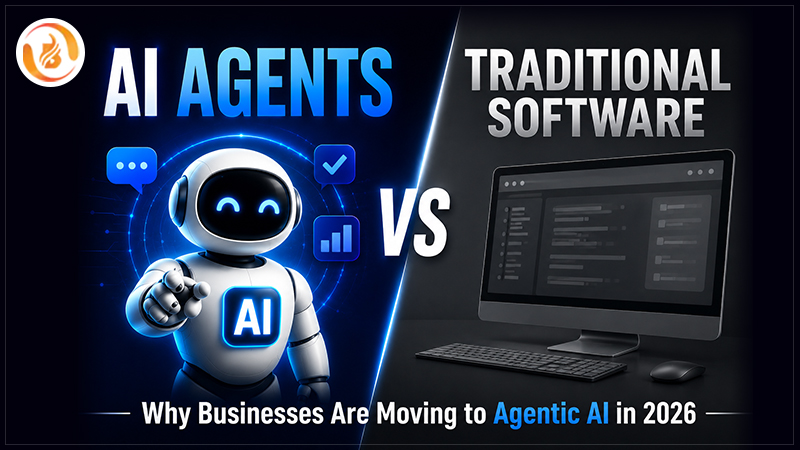
AI Agents vs Traditional Software
| Feature | Traditional Software | AI Agents |
|---|---|---|
| Rule-Based Operation | Yes | No |
| Learns from Data | Limited | Yes |
| Decision Making | Human Driven | AI Driven |
| Workflow Adaptability | Low | High |
| Natural Language Understanding | No | Yes |
| Multi-Step Task Execution | Limited | Advanced |
| Automation Level | Moderate | High |
The key difference is that traditional software follows instructions, while AI agents work toward achieving objectives.
Why Businesses Are Moving to Agentic AI in 2026
1. Increased Productivity
Organizations are under constant pressure to improve efficiency. AI agents automate repetitive tasks such as data entry, report generation, customer support, appointment scheduling, and document processing.
This allows employees to focus on strategic activities instead of routine operations.
2. Better Customer Experience
Modern customers expect fast and personalized responses. AI-powered agents can provide 24/7 support, answer questions instantly, and resolve issues without long waiting times.
Businesses using AI customer service solutions can significantly improve customer satisfaction while reducing operational costs.
3. Smarter Decision Making
AI agents analyze large volumes of business data in real time and generate actionable insights.
Whether it is sales forecasting, inventory optimization, risk assessment, or market analysis, AI-powered systems help businesses make informed decisions faster than traditional software.
4. Reduced Operational Costs
Many organizations are adopting AI automation solutions to reduce dependency on manual processes.
By automating workflows and minimizing human errors, businesses can lower operational expenses and improve resource utilization.
5. Scalability and Flexibility
Traditional software often requires additional customization when business needs evolve.
AI agents are more adaptable and can learn from new information, making them ideal for growing organizations that need flexible technology solutions.
The Role of AI Agent Development Companies
As demand increases, businesses are partnering with AI development companies to build custom AI agents tailored to their specific requirements.
These solutions can integrate with:
- CRM platforms
- ERP systems
- Cloud applications
- Internal databases
- Customer support tools
- Business intelligence platforms
Custom AI agent development enables organizations to automate complex workflows while maintaining full control over business processes.
The Future of Agentic AI
The future of business technology is moving beyond simple automation. Agentic AI systems are becoming capable of planning tasks, coordinating workflows, and collaborating with both humans and other AI systems.
In the coming years, organizations that embrace AI-powered business automation will gain a competitive advantage through faster operations, improved customer experiences, and enhanced decision-making capabilities.
While traditional software will continue to play an important role, AI agents are emerging as the next evolution of enterprise technology.
Conclusion
The shift from traditional software to AI agents is one of the most significant technology transformations of 2026. Businesses are no longer looking for tools that simply execute commands; they need intelligent systems that can understand objectives, adapt to changing environments, and drive meaningful outcomes.
By adopting AI agent solutions, organizations can improve productivity, reduce costs, enhance customer experiences, and unlock new opportunities for growth in an increasingly digital world.
Visit: www.biovustechnologies.com
Frequently Asked Questions (FAQs)
1. What is an AI Agent?
An AI Agent is an intelligent software system that can analyze information, make decisions, perform tasks, and achieve goals with minimal human intervention.
2. How are AI Agents different from traditional software?
Traditional software follows predefined rules, while AI agents can learn from data, adapt to new situations, and make intelligent decisions.
3. Why are businesses adopting Agentic AI in 2026?
Businesses are adopting Agentic AI to improve productivity, automate workflows, reduce costs, enhance customer experiences, and make faster data-driven decisions.
4. Can AI Agents replace traditional software?
Not entirely. AI agents often work alongside traditional software by enhancing automation and decision-making capabilities.
5. Which industries benefit most from AI Agents?
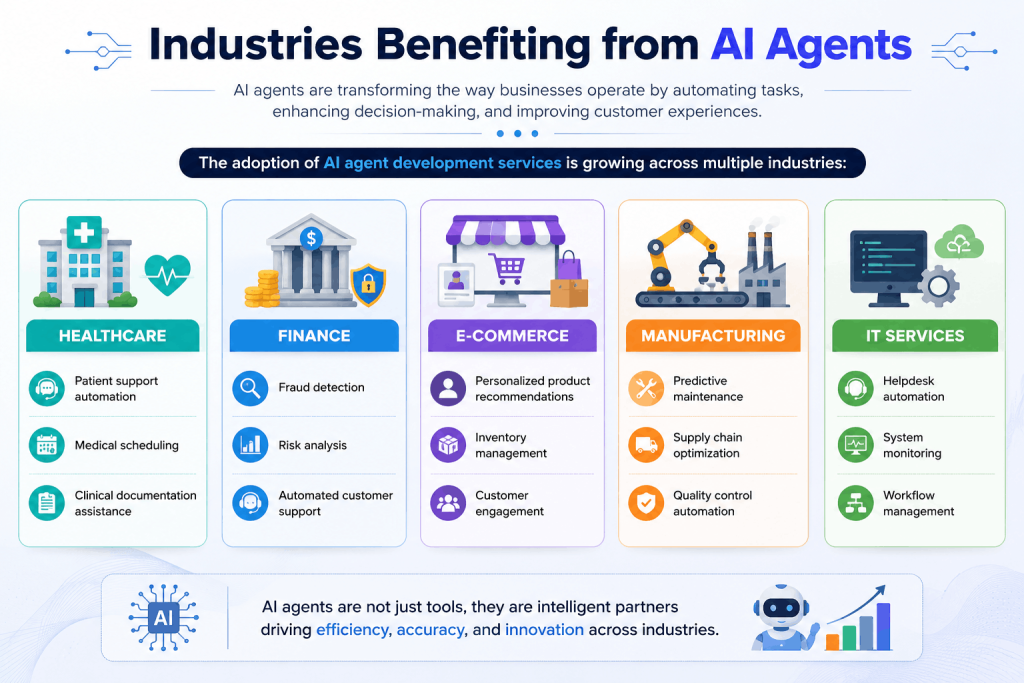
Healthcare, finance, e-commerce, manufacturing, logistics, education, and IT services are among the industries benefiting significantly from AI agent technology.
6. Are AI Agents suitable for small businesses?
Yes. AI-powered automation solutions can help small businesses streamline operations, improve customer support, and increase efficiency without large investments.
7. What is Agentic AI?
Agentic AI refers to AI systems that can independently plan, reason, make decisions, and execute actions to achieve specific objectives.
8. How can businesses get started with AI Agent development?
Businesses can begin by identifying repetitive processes, defining automation goals, and partnering with an experienced AI development company to build customized AI agent solutions.