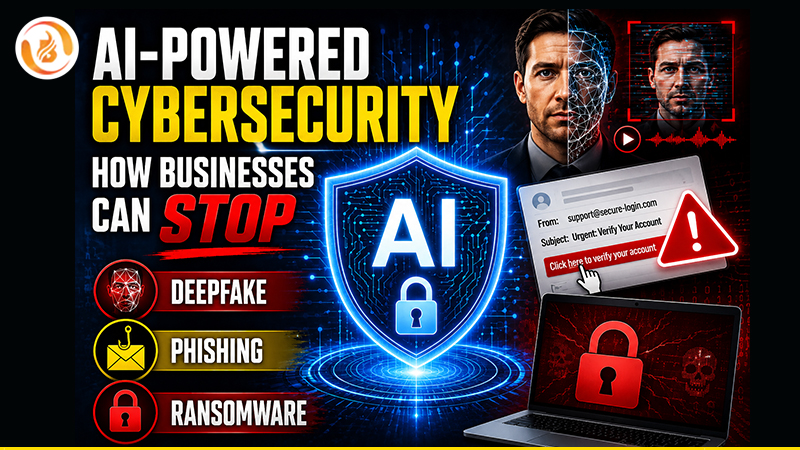
Cyberattacks are no longer limited to suspicious links and basic viruses. Today, criminals use AI to create realistic phishing emails, cloned voices, deepfake videos and ransomware campaigns. For businesses, this creates a risk to money, customer information, reputation and operations.
AI-powered cybersecurity helps organizations identify unusual behaviour, block threats early and respond faster than traditional security tools alone. It combines human expertise, threat intelligence, automation and continuous monitoring to create stronger digital protection.
What Is AI-Powered Cybersecurity?
AI-powered cybersecurity uses artificial intelligence, machine learning and automation to detect patterns that may indicate a cyberattack. Instead of checking only known malware signatures, it can flag unusual login locations, abnormal data downloads, suspicious email language and unexpected activity on devices or cloud accounts.
The purpose is to detect threats earlier, reduce manual workload and help security teams make faster decisions. AI can process large amounts of data quickly, making it useful for businesses that handle customer data, online payments, cloud systems and remote work environments.
Why Businesses Need AI Security Now
A single fake invoice, impersonated executive call or infected attachment can cause major financial damage. Small and medium-sized businesses are often targeted because attackers may expect weaker controls and limited monitoring.
AI improves cybersecurity by analysing large volumes of activity in real time. It can rank alerts by risk, identify threats that humans may miss and support faster containment. However, AI is not a replacement for skilled cybersecurity professionals. The strongest protection comes from combining AI tools with security policies, employee awareness and expert incident response.
How AI Helps Stop Modern Cyber Threats
1. Deepfake and impersonation attacks
Deepfakes can imitate a leader’s face or voice to request payments, passwords or confidential files. AI-based monitoring can detect unusual communication patterns, while strong verification procedures help employees avoid acting on urgent requests without confirmation.
Businesses should establish simple approval processes for financial transfers, sensitive data sharing and password-reset requests. A quick call-back or second-level approval can prevent expensive deepfake fraud.
2. AI-driven phishing attacks
Phishing emails are becoming more convincing, often using personal details and familiar branding. AI email-security tools can analyse sender behaviour, link reputation, language patterns and attachment risk before an email reaches an employee.
This helps businesses identify dangerous emails faster. Still, employees must be trained to verify links, attachments and unexpected payment requests before taking action.
3. Ransomware attacks
Ransomware encrypts business data and demands payment to restore access. AI-powered endpoint protection can identify suspicious file changes, unusual encryption activity and unauthorized software behaviour.
Early detection can isolate the affected device before the attack spreads across the network. Regular backups and tested recovery plans are equally important because they help a business restore critical files without depending on attackers.
Choosing the Right Cybersecurity Partner
When searching for the Best cybersecurity service provider in India, do not choose only by price or a long tool list. Choose a provider that understands your business, maps security risks and offers continuous support.
A reliable cybersecurity partner should provide:
- Vulnerability assessment and penetration testing
- Endpoint, email, network and cloud security
- Security awareness training for employees
- Threat monitoring and incident-response support
- Backup and disaster-recovery planning
- Compliance guidance and security reporting
Businesses looking for a top cybersecurity service company in Tamil Nadu should also check local support availability, response timelines and relevant industry experience.
For organizations searching for the best cyber security service company in Salem, clear communication, practical advice and fast on-site coordination can be as valuable as advanced technology.
A Practical Cybersecurity Checklist
Every business should start with these five priorities:
- Enable multi-factor authentication for email, cloud and finance-related accounts.
- Update operating systems, applications and security tools without delay.
- Train employees to verify payment requests, links and attachments.
- Back up critical data and test restoration regularly.
- Create an incident-response plan with named contacts and clear escalation steps.
These actions reduce the risk of common attacks and help the organization recover faster when a security incident occurs.
Conclusion
AI-powered cybersecurity gives businesses a smarter way to defend against deepfake fraud, phishing and ransomware. It works best when paired with strong policies, trained employees, secure infrastructure and expert support.
Cybersecurity should not be treated as a one-time setup. It is an ongoing business priority that protects operations, customer trust and long-term growth.
Visit: www.biovustechnologies.com
FAQs
1. What is AI-powered cybersecurity?
It uses AI and automation to detect unusual activity, prioritize threats and support faster security responses.
2. Can AI stop phishing emails?
AI can identify suspicious senders, links, language and attachments, but employee verification is still important.
3. What is a deepfake cyberattack?
It uses fake audio, video or images to impersonate trusted people and manipulate employees.
4. Can ransomware be prevented?
Risk can be reduced with backups, endpoint protection, updates, access controls and employee training.
5. Is cybersecurity necessary for small businesses?
Yes. Small businesses are common targets because attackers often expect fewer security controls.
6. What is multi-factor authentication?
It requires an additional verification step, such as an authenticator code, beyond a password.
7. How often should a business conduct a security assessment?
At least once a year, and whenever major systems, applications or cloud environments change.
8. Why is employee cybersecurity training important?
Employees can prevent many attacks by recognizing suspicious emails, calls and payment requests.
9. What should a cybersecurity service provider offer?
It should offer risk assessment, monitoring, security tools, employee training and incident-response support.
10. What should I do after a suspected cyberattack?
Disconnect affected systems when safe, preserve evidence and contact your IT or cybersecurity response team immediately.