In the fast-paced world of digital marketing, staying ahead requires automation, precision, and scalability. One of the most powerful tools to achieve this is API-based automated advertising. Unlike traditional manual campaigns, which require marketers to log in to platforms and create ads one by one, API-based automation allows campaigns to be created, managed, and optimized programmatically, saving time and maximizing ROI.
In this blog, we’ll dive deep into what API-based advertising is, how it works, its benefits, use cases, and how businesses can implement it effectively.
1. What is API-Based Automated Advertising?
API-based advertising refers to the use of Application Programming Interfaces (APIs) provided by advertising platforms such as Google Ads, Meta Ads, LinkedIn Ads, TikTok Ads, and others to programmatically manage ad campaigns.
In simple terms:
- Instead of manually creating ads through the platform dashboard, marketers can write scripts or use automation tools to create, update, and monitor ads.
- APIs act as a bridge between your system and the ad platform, allowing your software to communicate directly with the platform.
Example:
An e-commerce website can automatically create ads for 1,000 products by sending information (product name, price, image, URL) through the Google Ads API, without manually logging in.
2. How API-Based Automated Ads Work
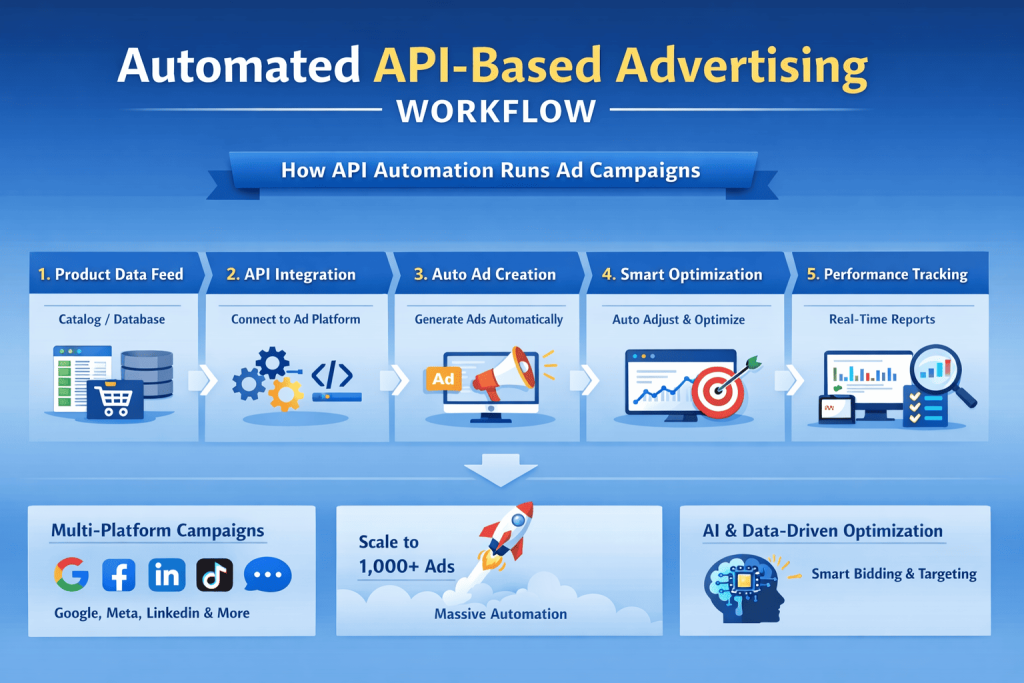
The workflow of API-based advertising is straightforward but powerful:
- Data Input: Feed comes from product catalogs, user behavior databases, or CRM systems.
- API Integration: Your system sends campaign, ad group, and ad information to the platform via its API.
- Ad Creation & Targeting: Ads are automatically created with predefined rules for budget, audience, bidding, and placement.
- Performance Monitoring: API allows real-time fetching of impressions, clicks, conversions, and ROI.
- Automated Optimization: Based on performance, campaigns can be automatically adjusted — pausing low-performing ads, increasing budgets for high-performers, or rotating creatives.
Platforms that support API-based advertising:
- Google Ads API
- Meta Marketing API
- LinkedIn Marketing API
- Snapchat Marketing API
3. Benefits of API-Based Automated Advertising
a) Massive Scalability
With API-based automation, marketers can manage hundreds or thousands of ads simultaneously.
This is ideal for:
- E-commerce businesses with large product catalogs
- SaaS companies with multiple campaigns per client
- Agencies managing multiple accounts
b) Real-Time Optimization
- Monitor ad performance in real time
- Automatically pause ads with low ROI
- Increase budget for high-performing campaigns
- Test multiple ad variations (A/B testing) automatically
c) Time Efficiency
- Manual campaign creation is repetitive and slow
- API automation reduces hours of work to minutes
- Marketing teams can focus on strategy instead of execution
d) Multi-Platform Campaign Management
- APIs allow marketers to run campaigns across multiple platforms simultaneously
- Data is centralized, making reporting and optimization seamless
e) Data-Driven Marketing
- Direct access to metrics via API
- Enables predictive algorithms to optimize bidding and targeting
- Supports integration with CRM, analytics, and AI-driven automation
4. Use Cases of API-Based Automated Advertising
1. Dynamic Product Ads
- Scenario: E-commerce stores with thousands of products
- How it works: Product catalog is linked to the ad platform via API. Ads are automatically generated and updated as inventory or prices change.
- Example: A fashion store automatically advertises new arrivals or discounts to users who viewed related products.
2. Retargeting and Remarketing
- Scenario: Users visited a website but didn’t convert
- How it works: API automation adds users to retargeting lists and delivers ads across platforms dynamically
- Example: A user views a smartphone but doesn’t buy. Automated ads show the same product on Instagram, Facebook, and YouTube.
3. Multi-Platform Campaigns
- Scenario: Companies managing campaigns on Google, Meta, LinkedIn, TikTok
- How it works: API integration allows marketers to push campaigns simultaneously across platforms, keeping targeting consistent.
- Example: A SaaS company launches a product campaign across all networks automatically.
4. Real-Time Event Triggered Ads
- Scenario: Ads triggered by specific events
- How it works: APIs can create ads automatically when conditions are met
- Example: During a live sports event, a brand automatically pushes merchandise ads based on in-game activity.
5. Automated Bidding and Budget Management
- Scenario: Maximize ROI on advertising spend
- How it works: API scripts adjust bids and budgets based on performance metrics in real time
- Example: Increase bids for products with high CTR, pause ads with low conversions.
5. Tools and Platforms for Non-Coders
Even if you don’t know programming, you can leverage API-based automation using no-code platforms:
| Tool | Features |
|---|---|
| Optmyzr | Automated campaign creation, reporting, optimization |
| Adzooma | Smart automation, campaign management, alerts |
| Zapier / Make | Event-based ad automation (e.g., new product triggers ads) |
| Smartly.io / Kenshoo | Enterprise-level automation with AI optimization |
These tools use APIs behind the scenes, allowing marketers to automate campaigns without writing a single line of code.
6. Difference Between Manual Ads and API-Based Ads
| Feature | Manual Ads | API-Based Ads |
|---|---|---|
| Campaign Creation | Manual, platform by platform | Automated, scalable, via scripts or tools |
| Optimization | Manual adjustments | Automated, real-time adjustments |
| Scale | Limited | Hundreds/thousands of ads simultaneously |
| Multi-Platform | Tedious | Centralized, programmatic |
| Data Access | Manual reports | Real-time via API |
| Efficiency | Low | Very high |
7. Future of Digital Marketing
API-based advertising is not just a trend — it’s the future:
- AI and predictive analytics are being integrated
- Dynamic ads will dominate e-commerce and SaaS marketing
- Real-time, cross-platform campaigns will become standard
- Marketing teams will focus more on strategy and creativity, while APIs handle execution
Marketers who embrace API-based automation will have a significant competitive advantage, being able to scale campaigns, reduce costs, and target users more precisely than ever before.
8. Conclusion
Automated API-based advertising is a game-changer for digital marketing. It enables businesses to:
- Run thousands of ads simultaneously
- Optimize campaigns in real-time
- Retarget users across multiple platforms
- Integrate AI and predictive algorithms into campaigns
- Save time while maximizing ROI
Even marketers without coding skills can implement API-based automation using no-code platforms like Optmyzr, Adzooma, or Zapier, making it accessible to businesses of all sizes.
By understanding and adopting API-based automated advertising, marketers can unlock true scalability, efficiency, and precision in their campaigns, staying ahead in the increasingly competitive digital landscape.
Are you a business owner or looking to enhance your brand digitally? Biovus Blockchain Technologies is here to help.
We are the best digital marketing agency in Tamil Nadu, providing cutting-edge digital advertising solutions, including automated API-based campaigns, retargeting, dynamic product ads, and multi-platform marketing.
Grow your brand with scalable, automated, and AI-optimized marketing campaigns that deliver measurable results.
Visit us at: www.biovustechnologies.com
FAQ
1. What is API-based automated advertising?
It is a method of creating and managing ads automatically using platform APIs instead of manually creating campaigns.
2. Can API-based ads handle thousands of products?
Yes! Large e-commerce stores can automatically run ads for hundreds or thousands of products simultaneously.
3. Do I need coding skills to use API-based advertising?
Not necessarily. No-code tools like Optmyzr, Adzooma, or Zapier allow automation without coding.
4. Which platforms support API-based advertising?
Google Ads, Meta Ads, LinkedIn, TikTok, and Snapchat all have APIs for ad automation.
5. How does API-based automation improve ROI?
It allows real-time optimization, pausing underperforming ads, scaling high-performing campaigns, and predictive targeting.
6. Can API-based ads run across multiple platforms?
Yes, APIs allow cross-platform automation, centralizing campaigns for consistent targeting.
7. What is the difference between manual ads and API-based ads?
Manual ads are created individually and updated manually. API-based ads are automated, scalable, and optimized in real-time.
8. What is dynamic product advertising?
It is automatically showing personalized ads for products a user viewed or interacted with on your website.
9. How does retargeting work in API-based ads?
Users who visited your website are automatically added to a retargeting audience, and relevant ads are displayed across platforms.
10. Is API-based advertising the future of digital marketing?
Yes. It offers scalability, automation, AI integration, and real-time optimization, which are essential for modern marketing.